


Discover Our New Museum
Museum of the
American Revolution
A Wismer Family Collection
Immerse yourself in history at Northern Star Farm's latest addition - a museum showcasing a vast collection of authentic Revolutionary War artifacts, featuring 30 different areas of military and domestic interests.
Explore the exhibits, learn about our nation's past, and witness the stories behind each piece.

Owner Matthew Wismer
shown here with an “Indianized”
Brown Bess fur trade musket.
Meet Matthew G. Wismer
Collector, Curator, and owner of Northern star Farm
Welcome to our museum, a collection of 18th century artifacts assembled over several lifetimes.
This collection was started by my late parents, Charles Wismer Jr., and his wife Jane,
the Second Generation owners of this farm.
As with many collections of the time period, you will also find treasures from the French and Indian War
(1754-1763) and the War of 1812 (1812-1815) all carefully collected, preserved and categorized for you viewing pleasure.
About mgw
From an early age, I was immersed in the world of history and collecting. My parents shared a deep passion for discovering the past—traveling to antique shows, visiting with antique dealers, and exploring historic sites. They brought me along on those journeys, passing down not only their knowledge but their reverence for the craftsmanship and resilience of our forefathers.
That early influence shaped my own dedication to seeking out and preserving the hand-crafted objects that tell the story of how people lived, worked, and endured during the formative years of this nation. What began as a shared family interest has grown into a lifelong commitment to acquiring and safeguarding these rare and meaningful artifacts.
why collect?
"If there is any advice that a lifetime of collecting might make relevant, is that one should strive to avoid becoming a mere possessive and covetous accumulator…may we be ever mindful the measure of a man is not the number of timekeepers he possesses but how he accounts for the time Divinity vouches safe to him, the wisdom he shares with his fellow human beings, and the legacy he leaves for those who follow." - MGW
18th century “Half Pounder” anti-personnel Swivel Ship Cannon
c. 1700-1750.
These guns were mounted on a sailing ship’s side, stern, bow, and tops (up on the mast platforms). Particularly affective when loaded with shards of glass, nails or multiple musket balls when firing at an adversary in action.
These guns were favored by pirates, merchantmen, and privateers of all nations.
The American Revolution marked the period of their most prolific use.

Pictured:
Collector Matthew G. Wismer, Owner of Northern star Farm

Colonial Gentlemens Attire
One of several 18th Century Gentlemen's
costumes featured in the collection.
This costume, made of black and gold silk, was custom made for Frederick Grimison.
Grimson was the last private owner of the
Henry Muhlenberg house and
founder of the Trappe Historical Society.
Musket Collection
The principle shoulder weapon of the American Revolution was the smoothbore flintlock musket.
Most battles fought with two to three lines of men armed with these muskets standing shoulder to shoulder. Many types of shoulder arms were used by the American patriots.


Muhlenburg Letter
Authentic letter written or dictated by
Henry Muhlenberg on August 26th, 1748
The content of this letter disputes the placement of East 7th in Trappe, PA
Saddlebags
Superb original Saddlebags made of pigskin used during the American Revolution.
Saddlebags were used to carry personal effects while traveling on horseback during the Colonial Period.
Authentic saddlebags are now nearly impossible to find.
For all enthusiasts of Colonial Cavalry.
Ex Don Troiani Collection.

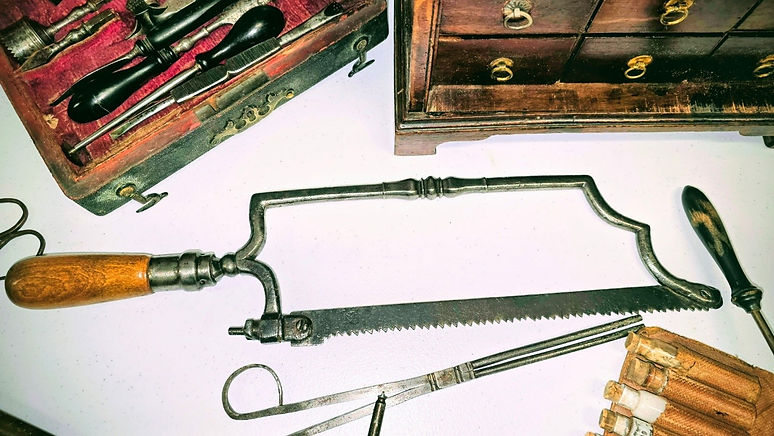
Medical Collection
A small snippet of the museum’s large medical collection.
Rope Tension Field Drum
This field drum was made by
Thomas Bringhurst of Germantown, PA.
This drum features an early handwritten label inside indicating this was one of his earliest creations.


18th Century Currency
The confusing chaos of 18th century money is explained in the museum’s currency display.
The collector stands next to the museum’s 18th century “Half Pounder” anti-personnel Swivel Ship Cannon c. 1700-1750.
These guns were mounted on a sailing ship’s side, stern, bow and tops (up on the mast platforms). Particularly affective when loaded with shards of glass, nails or multiple musket balls when firing at an adversary in action.
Favored by pirates, merchantmen and privateers of all nations. The American Revolution marked the period of their most prolific use.

Trade sign
c, 1790-1810
Hand carved trade signs were used to advertise the contents of a store for a largely illiterate population.
This sign was used as advertising for a store selling items such as pipes, tobacco, paper to roll cigarettes, snuff etc.
Bottle Collection
A portion of the museums 18th Century Bottle Collection

What People Are Saying


